Hendersonville
I don't usually like to post stuff that's personally identifialble, like family details etc. But there are enough people out there who are descendents of the folks I'm going to talk about that (a) they might find this interesting and (b) there's nothing particularly personally identifiable about it.
This information all came to light when we (my wife and I) were looking through family history for name ideas for our son. We didn't actually use any of the names we found in our family trees, but the name we settled on is a sort of homage to some of the history we uncovered -- i.e., it's an Irish and Scottish Gaeilic name, and we used a spelling that's similar to the Irish name, rather than the Anglicized version. (I feel a little bit bad that he'll have to always explain how to spell it, but I also think it's a really cool name. See also: my name, Sean, which is the Irish equivalent of the name John.)
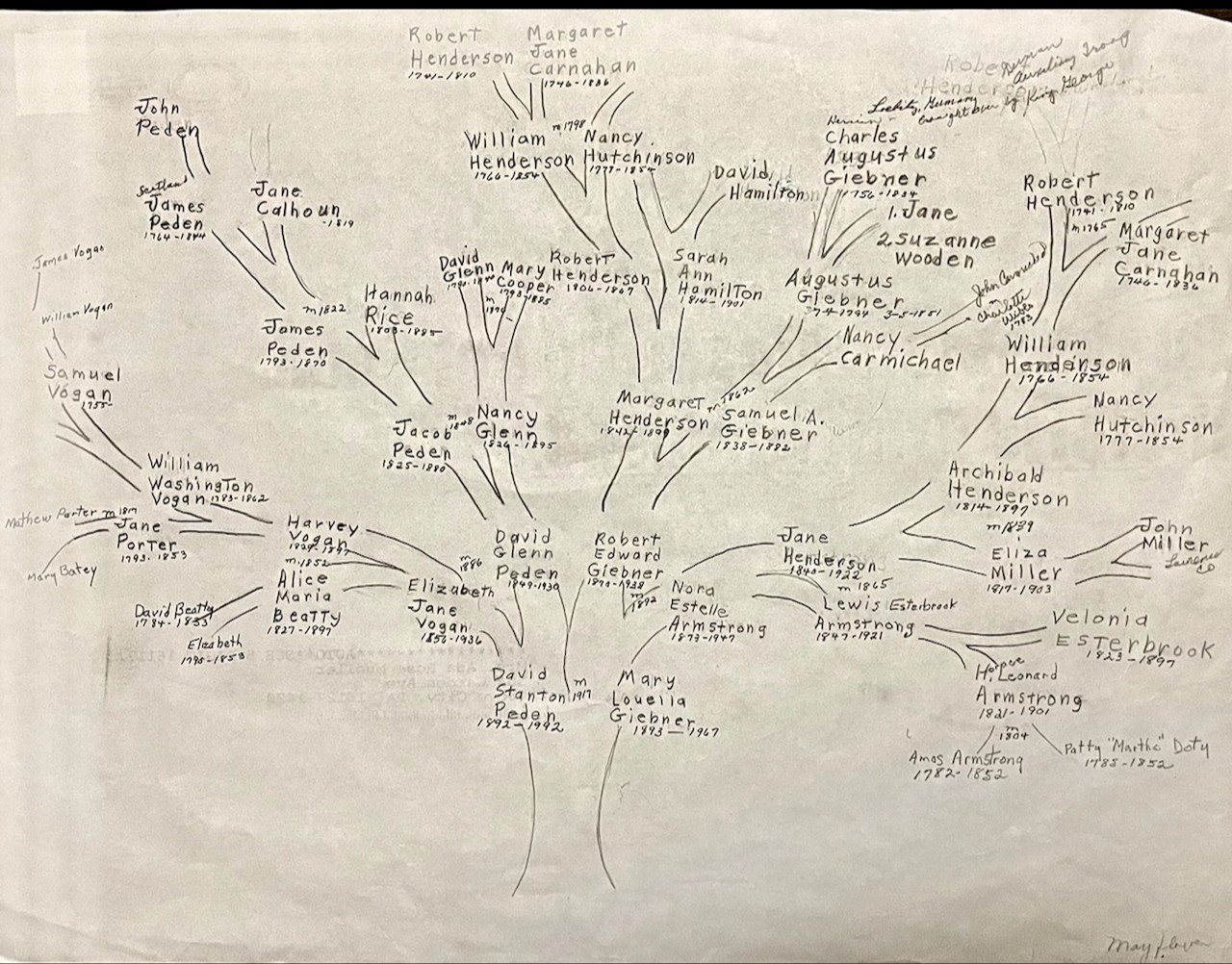
The first piece of family history we found was a family tree given to me by my mother, which had apparently been either compiled or corrected by my grandmother (her mother). In one of the branches of the tree, I was informed, were the Hendersons, who migrated to the US from Scotland and had apparently founded a village now called Hendersonville. She (my mother) told me that we had some ancestors in the cemetary located near Hendersonville. Well, by complete coincidence, 3 years prior we had bought a house a few miles from Hendersonville, just inside the border of the neighboring county. So one day, armed with that family tree, my expectant wife and I decided to go see if we could find any familiar headstones. We did! But not the ones we expected. The first names we found were the Armstrongs, which were part of the Henderson branch of the tree and appeared to be intermingled with some of the 19th century Hendersonville history. We did ultimately find some Hendersons too of course, but none that we recognized. Regardless, it was inspiring to find tangible evidence of family history so close to where we had just moved.
From there I started poking around the internet with random web searches of the names we'd found, and discovered that there's a web site called "Find A Grave", where Horace Leonard Armstrong (one of the headtones we'd found) had not just a page identifying his grave, but there was a picture of him too. Some of the links on the site led to pages for his children, wife, and parents, which confirmed some of the connections in the tree I'd been given. Horace and his wife Velonia (man I love the names from this time period) had a son Lewis Armstrong, who also had a picture on the site but his headstone was not in the same cemetery. Lewis married Jane Henderson, whose page I found, and from there I was able to ascend up the tree all the way to William Henderson's profile. It turns out that William and his wife Nancy are buried in a cemetery that's even closer to our house, across the road from an old Prebyterian church. William's parents, Robert and Jane (Callahan) Henderson are buried there too. There are lots of other cool old photos from some adjacent family tree branches, so I could get a very vague sense of what they all would have looked like. Since they were buried in the church's cemetery, I can only assume that means they used to attend the church. Then it hit me... our house was built in the mid 19th century and is just over a mile away. It's likely the Hendersons and Armstrongs knew of it and maybe even saw it being built... perhaps it was built by one of them? Who knows.
A little bit more digging and I found a couple of interesting tidbits. The first was written on William Henderson's page. I'm not sure who wrote it but it gave me some more clues to follow:
Husband of Nancy: It is possible that William, who would have been about 27 years of age and his eldest son, made the journey earlier and alone to scout out the new land. It is known that the entire family was in the village of Pittsburgh in late summer of 1795. Oral history has it that the marriage took place at Carlyle, PA, but there is no facutal evidence. Nancy was born about 1777, but the place of her birth is unknown. She would have been about 17 years of age at the time of her marriage. In the last summer or fall of 1794/95, William and two or possible three of the brothers, journeyed north to mark out their respective 400 acre tracts. It is to be remembered that the entire area north of Pittsburgh was forest. The path of their trip is as follows: They went twelve miles north of Pittsburgh to a place called "Burnn's STand" where they picked up an Indian trail that ran near the divide between the Allegheny, Beaver and Shenango Rivers. It then crossed a place they called "Bald Nob" where the town of Harrisville now stands. From there, the trail continued by a hemlock swanp and through a recently deserted Indian village, then along what is now Wolf Creek, passing through where Millbrook is now Located. On past the present location of current Fairview Cemetery. There the trail forked - one branched northwest to a large Indian village. The other branch went east to the land the Hendersons were to occupy. The trail passed around the hill where the Hendersonville Cemetery is now located. After marking out their claims, to include 400 acres for their father, they made the 60 mile trip back to Pittsburgh, to spend what was reported to be a very bitter winter. In the early spring of the following year, the Henderson Party again set out north to settle the lands they had marked out. This time Williams wife Nancy was included. Letitia Williams sister had met and married a man surnamed Epley and remained in Pittsburgh. The two youngest children, Margaret and Archibald stayed with their parents near Pittsburgh. The journey progressed at a slow pace due to the fact farm implements, cooking utensils and live stock including a cow and a horse were included in the procession. History does not tell us if pigs and chickes were part of this menagerie, but in all probably they were. a large dog belonging to William is mentioned. It was probably March or early april whent hey made this trip. It would be imperative to clear some of the land and plant some sort of cereal crop, also to build shelters adequate enough to survive the winter. Initially they slept under the trees and later improvised lean-tos to keep out the rain of the spring storms. The History of Mercer County, published 1888, recounts many of Willliam's experiences in the wilderness, the most prominent being his skill at killing black bears with a staff. It also has an account of how Slippery Rock Creek got it's name due to Nancy almost drowneding when the horse she was riding slipped and fell whild crossing on the trip North. William died on Oct 27, 1854 at the age of 87 in Henndersonville. while attenpting to dismount his horse , he lost his balance and fell backwards, hitting his head and shoulders, and died almost instantly, probably from a broken neck. Nancy died the following month Nov. 28 1854 at Hendersonville. Both are interred in the Irwin Cemetery near Kilgore PA. This information was taken from the LDS (familysearch.org) website.
Some interesting info in here. The excerpt mentions Harrisville, Millbrook, and a hemlock swamp. I know of a hemlock swamp in between Harrisville and Millbrook... it's where Wolf Creek passes near Hemlock Road. I've hiked around a bit there because the swamp and creek pass through my wife's family's nearby farm. When you drive on Hemlock Road it takes on a very different, mysterious vibe because the tall, towering hemlock trees back in there make the place feel very old somehow. I can see why that specific place would have been remembered in their stories.
One more clue jumped out when reading this and it's the book called the History of Mercer County PA. Being public domain, I was able to find a copy of it on Archive.org. Here is an excerpt about the Hendersons:
WORTH TOWNSHIP
The first settlement effected in the township was that of the Hendersons. In the year 1796 five brothers, three of them named, respectively, William, Archibald and John, entered from the region lying near Pittsburgh, and, in accordance with the offer spoken of above, made settlements upon tracts of 150 acres each. After effecting a few improvements, blazing a few trees, and, in other ways securing their claims, they returned to their former homes to pass the severe winter which was just setting in. In the following year, with their families, they started on their journey to their new homes in Mercer County. Their progress was slow, and beset with many difficulties. The goods which they brought along, consisting of their provisions and necessary articles of household use all articles not absolutely indispensable being left behind were stowed away on the back of an old gray mare, the dilapidated saddle of which was for a long time preserved in the family as a memento of the tour. Mrs. William Henderson sat astride the animal, and it is related that while fording Slippery Rock Greek the party suddenly got in water beyond their depth, and in the struggle which ensued the horse, with all its burdens, capsized. The water flowed very rapidly, and it was by the merest accident that Mrs. Henderson, who was a large, stout woman, was saved. In the confusion a large pot hooked her under the arm and held her head above water until she was rescued. At length, however, after numerous annoyances and perils, of which the one narrated is but a specimen, the new homes were reached. The brothers had not erected any cabins as yet, and the party was forced to be without shelter, sleeping at night under the trees, on beds made of leaves, until small dwellings could be improvised. William Henderson, probably the most prominent of the brothers, succeeded in getting the first roof over his family’s heads. There was but one room in the shanty.
In the course of a few weeks this was decorated with rough hewn seats, and a table made of a huge log, hewn flat on the upper surface. Around this the family congregated at meal time and enjoyed their repast, which was exceedingly frugal. Game abounded, and with his trusty rifle Mr. Henderson supplied the meat used at his table. He at once began cultivating the ground, and preparing it for seed. In this task he was assisted by his wife, who was much larger and more powerful than he. The implements with which they set out to conquer the wilderness, consisted of two hoes and a mattock. In the use of the latter instrument they took turns. Henderson working with it until exhausted, and then giving place to his wife. When they came to fence in their cleared land she lifted the heavy end of the rails while he carried the opposite extreme. With them they had brought a cow and a dog. The former was almost indispensable to their existence, as it used often to supply food for the family when all other resources failed. The canine, which was a large and powerful one, was in the habit of accompanying its master upon all his expeditions into the forest in search of game. Upon one of these occasions it saw a large animal slowly moving along in the distance, and, without pausing to ascertain what kind of beast it was, the dog gave a bound and set upon it. The animal thus attacked proved to be an immense black bear, which no sooner beheld that its antagonist was a dog, than it immediately showed fight, and in a few moments had almost succeeded in killing it, when Henderson reached the scene, and with a large, keen knife which he carried, with a few dexterous strokes ended the struggle in favor of the dog, thus saving his faithful animal’s life. The other four brothers settled in the township at various places, one of them, John, locating a short distance north of the present site of the village of Hendersonville.
Some of the details in the book overlap with the find-a-grave text, and some conflicts. But that's typical of oral and written histories and lends to the authenticity of the stories. What drives me crazy though, is that this is just one branch of the family tree. Every branch is no doubt full of such stories... most now lost to time except this one which happened to be written down because of the fact that there's a tiny village named after them. There's not much there now, mind you, just a body shop and a church. But when I drive through there now I can't help but think of what adventures, besides killing a bear with a knife, might have taken place.
The last clue I'll mention is that the find-a-grave page for William Henderson mentions his birth in West Lothian, a council area in Scotland that would have been known at the time as Linlithgowshire. Poking around some old maps of the county town of Linlithgow, I kid you not, there is a mention of a "Mr. Henderson's property". This most likely was not my ancestors as the map was from 1820 and the Henderson brothers moved to the US in the 1790s, but perhaps an uncle or cousin? Again, who knows, there were and are many Henderson families. But I definitely want to visit Linlithgow someday and imagine that my five-greats grandfather likely would have walked those streets as a boy.